Is this guide for you? Use it if you make your own products, or pay someone to make them, and your packaging carries a UPC or EAN barcode. If you resell other brands, the barcodes on your stock belong to those brands, and any change to them is theirs to make. We make GS1 Assistant, a Shopify app that assigns GTINs from the block of numbers GS1 licenses to your business. It does not make 2D barcodes, and we say so where it matters.
What GS1 Sunrise 2027 Actually Is
GS1 Sunrise 2027 is GS1's goal for shop tills to read 2D barcodes, as well as today's striped ones, by the end of 2027. A 2D barcode is a square code, such as a QR code, that stores more data than the striped barcode on your packaging. GS1's own wording: "The initial goal is for retail point-of-sale (POS) scanning to be globally capable of reading and processing the GTIN from both existing linear and 2D barcodes by the end of 2027."
The goal has two names:
- Sunrise 2027 is what GS1 US calls it.
- Ambition 2027 is GS1's global name, used in Europe and elsewhere.
GS1 Germany, for one, states the same end-of-2027 goal for its own market. GS1 also says the change "unfolds progressively on different timelines across the globe", so 2027 is a target, not a single switch-over date.
Most of the work falls on shops. GS1 US's checklist for retailers is to "Install optical scanners that are Sunrise-capable to read 2D barcodes and extract the GTIN at POS."
Is Sunrise 2027 Mandatory for Brands?
No. GS1 Canada puts it plainly: "the transition to 2D barcodes powered by GS1 is optional for brand owners", and "the decision on timing will be made by the brand."
It is not a law either. It is an industry goal that GS1 coordinates. Even GS1 US says "it is not necessary to implement all the capabilities of 2D by that date."
Are UPC and EAN Barcodes Going Away?
No. The current GS1 guideline says it directly: "Linear barcodes (e.g., EAN/UPC and GS1 DataBar) will not go away and will coexist with 2D barcodes for as long as there are uses for them." "Linear" is GS1's word for the striped barcode you print today.
GS1 US says the same to American brands: "While 2D barcode use is increasing, the UPC barcode isn't going away." We searched GS1's sites and major retailers' published material for a date when UPC or EAN barcodes stop scanning, and found none.
Why the Headlines Say Otherwise
A widely shared October 2026 feature called barcodes "about to go extinct", and older trade stories said UPCs would be "replaced" in 2027. Part of the confusion starts with GS1 US's own marketing, which calls Sunrise 2027 "a global transition from 1D UPC barcodes to 2D barcodes".
That describes the long-term direction. GS1's written rules for brands keep your current barcode in place.
When a 2D Barcode Needs a UPC Next to It
If you add a 2D barcode to a pack, the striped barcode stays too. GS1's rule: "Until 90% of POS scanning solutions are capable of using GS1 compliant POS 2D barcodes and at minimum capture the GTIN, any products using retail 2D barcodes on-pack will need to be accompanied by a POS linear barcode."
Even after most tills can read 2D, you can keep only the striped barcode. Once 2D scanning is widespread, GS1 says a brand can use only the 2D barcode, both, "or stay with only the POS linear barcode."
What a 2D Barcode Adds, and Which Ones a Till Will Read
A striped barcode carries one thing: the product's GTIN. A 2D barcode can carry that GTIN plus extra data, such as:
- a batch or lot number
- an expiry date
- a serial number
- a web link to product information
Only three kinds of 2D barcode are on GS1's list for shop tills. In GS1's words: "the QR Code with GS1 Digital Link URI syntax, Data Matrix with GS1 Digital Link URI syntax and GS1 DataMatrix."
GS1 Digital Link is a web address with your GTIN built into it. The same square code can open a product page on a phone and ring up the product at a till. Data Matrix is another square code, made of small dots.
A Marketing QR Code Is Not a GS1 2D Barcode
A QR code that only points to your website will not ring up at a till. To count, the QR code has to carry a GS1 Digital Link address with your product's GTIN in it. GS1 Canada: "a GTIN is required to create a QR code with a GS1 Digital Link URI, as the GTIN serves as the key for product identification."
GS1 US gives brands with a QR code already on pack the same instruction: "ensure any existing QR codes are updated with GS1 Digital Link standards and include your Global Trade Item Number® (GTIN®)."
What Doesn't Change: Your GTIN
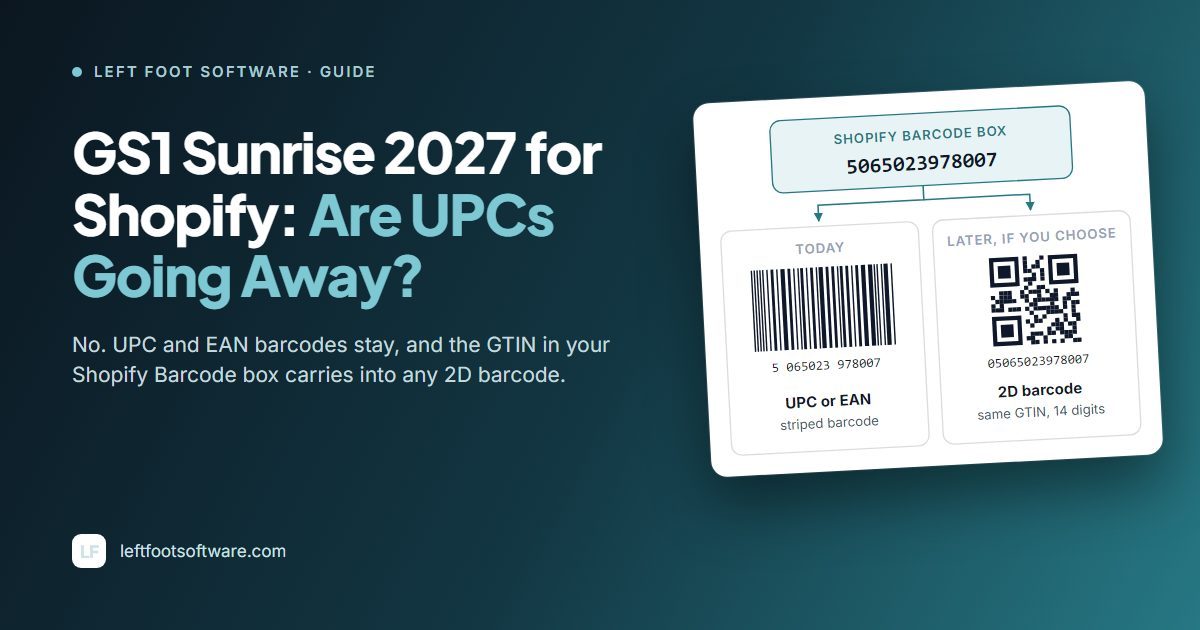
A GTIN (Global Trade Item Number) is the number underneath a barcode. A UPC is usually a 12-digit GTIN and an EAN usually a 13-digit one. In a 2D barcode the symbol changes and the GTIN stays the same.
GS1 Canada answers the question directly. Asked whether a 2D barcode needs a new GTIN: "No. The same GTIN that is in your linear barcode such as UPC-A barcode must be encoded in the 2D barcode powered by GS1, but the GTIN must be in 14-digit format." The 14-digit format just adds leading zeros to the number you already have.
What a 2D barcode needs from you later is a GTIN licensed to your business, on the right variant. If a variant has no GTIN, or has a number that isn't really yours, a 2D barcode won't fix it. It will carry the same problem in a newer symbol.
What It Means Inside Your Shopify Store
Shopify stores the barcode number. The printed symbol, striped or square, is made from the number when you design packaging or labels.
That is why the 2D change does not need anything new in your product data. Shopify's Help Center describes the Barcode box as holding a value that "can be a custom value or can be provided by a global registry, such as a Global Trade Item Number (GTIN)."
Two Different Things Called "2D"
As a Shopify seller you'll meet the word "2D" in two places that have nothing to do with each other:
| Where you see "2D" | What it is | Does it involve your product's GTIN? |
|---|---|---|
| Shopify POS scanners | Codes on gift cards and receipts that a 2D scanner reads at your till | No |
| GS1 Ambition / Sunrise 2027 | The QR code with GS1 Digital Link, Data Matrix with Digital Link, or GS1 DataMatrix on your packaging | Yes: it carries the same GTIN |
Shopify's product documentation says nothing about GS1 Digital Link or Sunrise 2027.
Shopify Now Allows Up to 20 Barcodes per Variant
Since September 2026, a variant in Shopify can hold more than one barcode. Shopify's Help Center: "You can add up to 20 barcodes to a product or a variant."
Each barcode can be given a type, and Shopify checks the format of typed values:
- The types are "UPC, EAN, ISBN, GTIN, or ASIN".
- Shopify checks a typed value "against that standard's format, so a mistyped digit gets caught as you enter it."
- "Custom" is the default type, and it accepts "Any barcode value, up to a maximum of 255 characters in length."
There is no 2D type on that list. A 2D barcode carries a GTIN, and the GTIN is what Shopify stores. One detail matters if you add extra barcodes: "Channels continue to read the first barcode provided." Keep your own GTIN in the first position.
Who Needs to Act, by Sales Channel
What you do depends on where your products are sold.
| Where you sell | What 2027 means for you | What to do now |
|---|---|---|
| Your own Shopify store only | Nothing changes at your checkout | Nothing for 2027. A real GTIN still helps if you list on Google Shopping |
| Google Shopping or Amazon | Marketplaces read the GTIN from your product data, not the printed symbol | Make sure each variant's GTIN is correct and licensed to you |
| Into shops, through a retailer or distributor | Retailers set their own supplier rules | Read your retailer's supplier guide. Keep the UPC or EAN on pack |
| You already print a QR code on packs | It won't ring up at a till unless it carries GS1 Digital Link with your GTIN | Move it to GS1 Digital Link at your next packaging update |
Google shows why the number matters today. Its help pages say "Products with an assigned GTIN, but submitted without one, may have limited visibility", and "If you provide incorrect identifiers, your product(s) may be disapproved." If Google is already flagging your products, our guide to Merchant Center GTIN errors in Shopify sorts out which problem you have.
What to Do Now, and What Can Wait
Now, whatever happens with 2D:
- Give every variant its own GTIN, licensed to your business by GS1. If GS1 hasn't licensed you a block of numbers yet (called a GS1 Company Prefix), how to get a GS1 Company Prefix walks through it.
- Find variants with no GTIN, a mistyped one, a placeholder, or the same GTIN as another product.
- Keep the UPC or EAN barcode on your packaging.
Later, when a retailer asks or you next redesign packaging:
- Add a GS1 2D barcode next to the striped one, using the same GTIN.
- Add batch or expiry data only if your printer can print it per batch.
Not needed:
- New GTINs for 2D.
- Removing the UPC or EAN barcode.
- Anything done by 31 December 2027 just because of the date.
Getting Your GTINs Right in Shopify
The native way works. You type each GTIN into the variant's Barcode box, or fill the Variant Barcode column in a product CSV and import it. Our guide to bulk-assigning GTINs to Shopify variants covers the CSV route step by step.
Shopify checks the format of a typed GTIN, so a wrong digit gets caught. What it can't tell you is whether the number belongs to you.
Shopify doesn't know your GS1 Company Prefix, which numbers in your range you've already used, or which ones you used outside Shopify. Its help page says the same value can't be used twice on one product or variant. It says nothing about the same GTIN on two different products.
If you want to weigh the tools that do check, our roundup of Shopify barcode and GTIN apps compares them.
On a catalogue of a few dozen products, a spreadsheet keeps track. With hundreds of variants, numbers get reused, skipped or typed onto the wrong size, and Shopify's documentation describes no check that would catch it. One store owner described their setup before switching:
"Before finding GS1 Assistant, our workflow relied heavily on manual Excel spreadsheets, GS1 imports, and countless hours of administrative work." (5★, 4 June 2026)
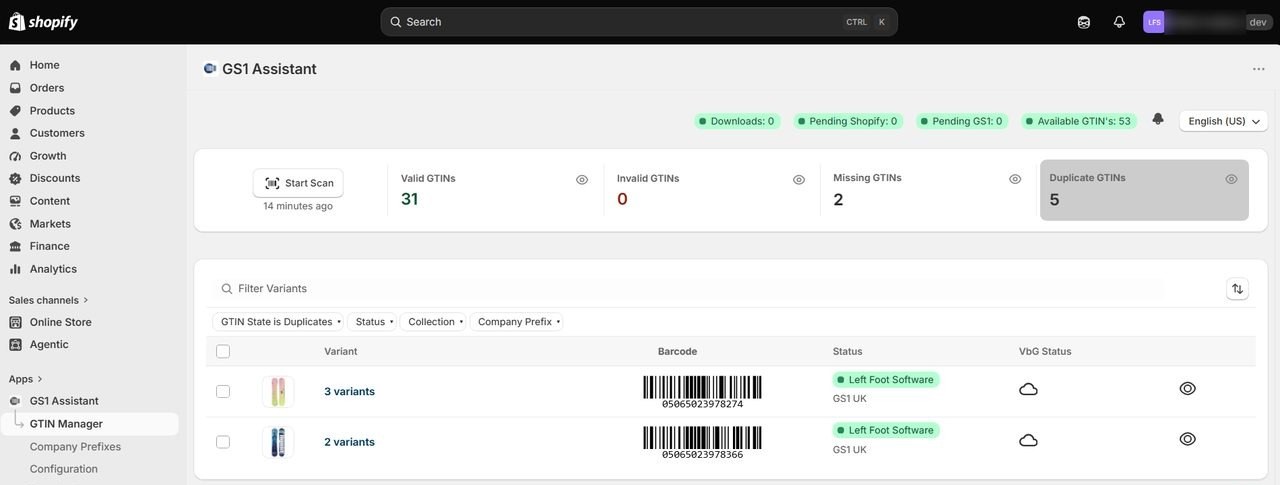
GS1 Assistant does this part inside Shopify:
- It assigns GTINs from your own GS1 Company Prefix, one per variant, and writes each one to the Barcode box.
- It flags missing, invalid and duplicate barcodes across your catalogue, and checks that each GTIN belongs to your prefix.
- It keeps a range and an exclude list, so numbers you used outside Shopify aren't handed out again.
- It gets the record back to GS1: automatically where your GS1 organisation has an API connection, or as a file you upload, where your GS1 organisation has a supported import format.
It does not make 2D barcodes, QR codes or GS1 Digital Link addresses. It looks after the GTIN those codes will carry.
See which of your variants need a GTIN
GS1 Assistant scans your Shopify catalogue against your GS1 Company Prefix and shows how many variants are valid, invalid, missing a GTIN or duplicated. Then it assigns the gaps from your own numbers.
Free to install; usage charges apply. It manages GTINs, not 2D barcodes.
Frequently Asked Questions
Are barcodes being phased out?
No. GS1 US says the UPC "isn't going away", and the GS1 guideline says striped barcodes will coexist with 2D barcodes "for as long as there are uses for them". We found no GS1 or retailer source that gives a date when they stop scanning.
Do I need new GTINs for 2D barcodes?
No. The 2D barcode carries the same GTIN as your UPC or EAN, written as 14 digits by adding leading zeros. If you already have GTINs licensed from GS1, you keep using them.
Can I put a QR code on my product instead of a UPC?
Not instead of. A QR code only rings up at a till if it carries a GS1 Digital Link address with your GTIN. Until 90% of tills can read 2D, it also needs a UPC or EAN next to it.
Does Shopify support 2D barcodes?
Shopify stores barcode numbers, and since September 2026 up to 20 per variant, typed as UPC, EAN, ISBN, GTIN, ASIN or Custom. It has no 2D type, because a 2D barcode carries a GTIN you already store. Shopify POS scanners read 2D codes on gift cards and receipts.
Do I need a 2D barcode if I only sell online?
No. Sunrise 2027 is about shop tills. Online marketplaces such as Google Shopping read the GTIN from your product data, not the printed symbol.
Fix the Number Now, Choose the Symbol Later
Over the next few years you may add a 2D barcode to your packaging. Any GS1 2D barcode you add will carry the GTIN that sits in your Shopify Barcode box today, so get that number right first.
GS1 Assistant assigns GTINs from a GS1 Company Prefix you already own, one per variant, and shows which ones are missing or duplicated. It's free to install, so you can check one product line before deciding. Usage charges apply.